
Kanji. Milestones Are Not Finish Lines.
Tests mark progress. They cannot mark just how far you can go with your Japanese.
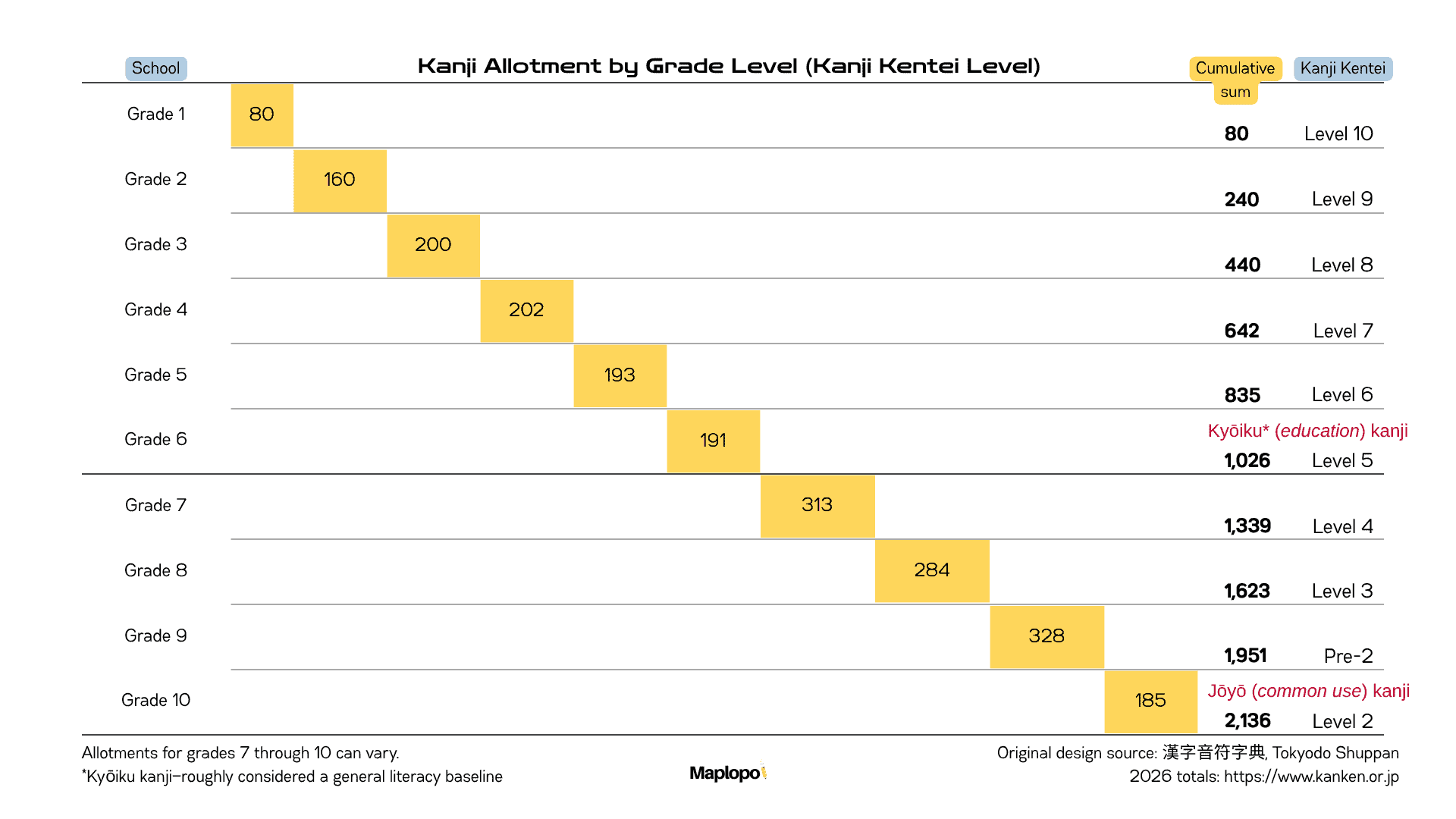
Eighty kanji… then 160, 200, 202, 193, 191, then… Another milestone, another exam, another box ticked. But Japanese literacy doesn’t end where the test does.

You wanna read more, write more, understand more, and think more in Japanese. The obvious killer to all those aspirations? A tenuous grasp of kanji.
Kanji can be a formidable foe: pedagogical frameworks, individual study habits, and the artificial partitioning of progress based on testing levels all conspire to keep us from the literacy we desire.
There’s a trick to conquering this last one. Simply reframe levels as waypoints that mark your ascent… instead of stopping points for you to don a set of laurels.
Seeing how the first 80 kanji taught in Grade 1 lead toward a landscape of 2,136—and how that journey maps onto the Kanji Kentei exams—can be instructive. Have a look at the attached image.
Benchmarks are good.
Goals are good.
Testing serves a purpose.
Stopping before we’ve truly begun is not.
There are many, many, many ways to learn kanji. Your best ally? Stories. Lots of ’em.
And this is no mystery, right? Nothing to second-guess.
Reading is a powerful engine of vocabulary growth during what we might call the “reading years” of our first language; it remains a tremendous ally when adding another language to our skill set. Each encounter with a word in a new context gives us another chance to understand it, recognize it, make it our own.
If you want literacy in Japanese, it is there for you to grab.
Set your sights on all the “general use” kanji… that not-so-big list of 2,136. It’s a true benchmark worth hitting, and one that will open the door to a virtuous cycle of acquisition and learning that will soon have you feeling quite… unstoppable.
Your first three steps?
Grab your compass. Know the territory. Keep going.